
Our approach
We start with the children, not the catalogue.
We design around the children who will use the space, the site itself and how it will actually be used — not around pre-designed catalogue products.
01 — Children first
The child's experience leads the design.
Before equipment, we think about experience: how children will move, where they'll gather, what they can change, what they can imagine — and what different children might need from the same space.
It's a slower way to start, and it's why our sites still hold children's attention years later.
02 — The 16 Types of Play
Designing for more than one way to play.
A playground can contain plenty of equipment and still offer surprisingly few ways to play. The framework helps us spot what may be missing before anything is built.
We don't start with equipment.
We start with possibilities.
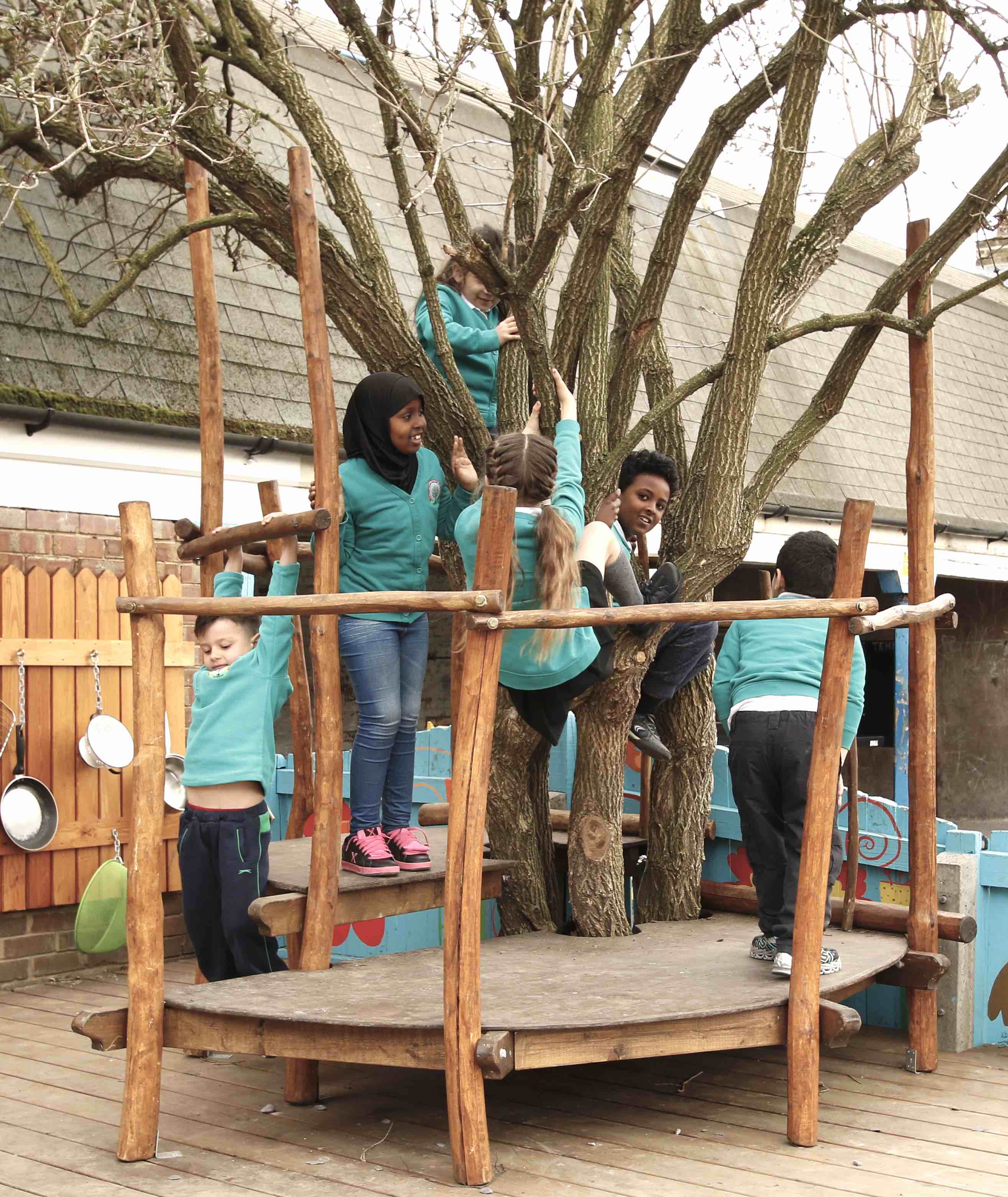
A strong play environment can support several kinds of play at once. A platform might become somewhere to climb, meet, hide or imagine depending on the child using it.
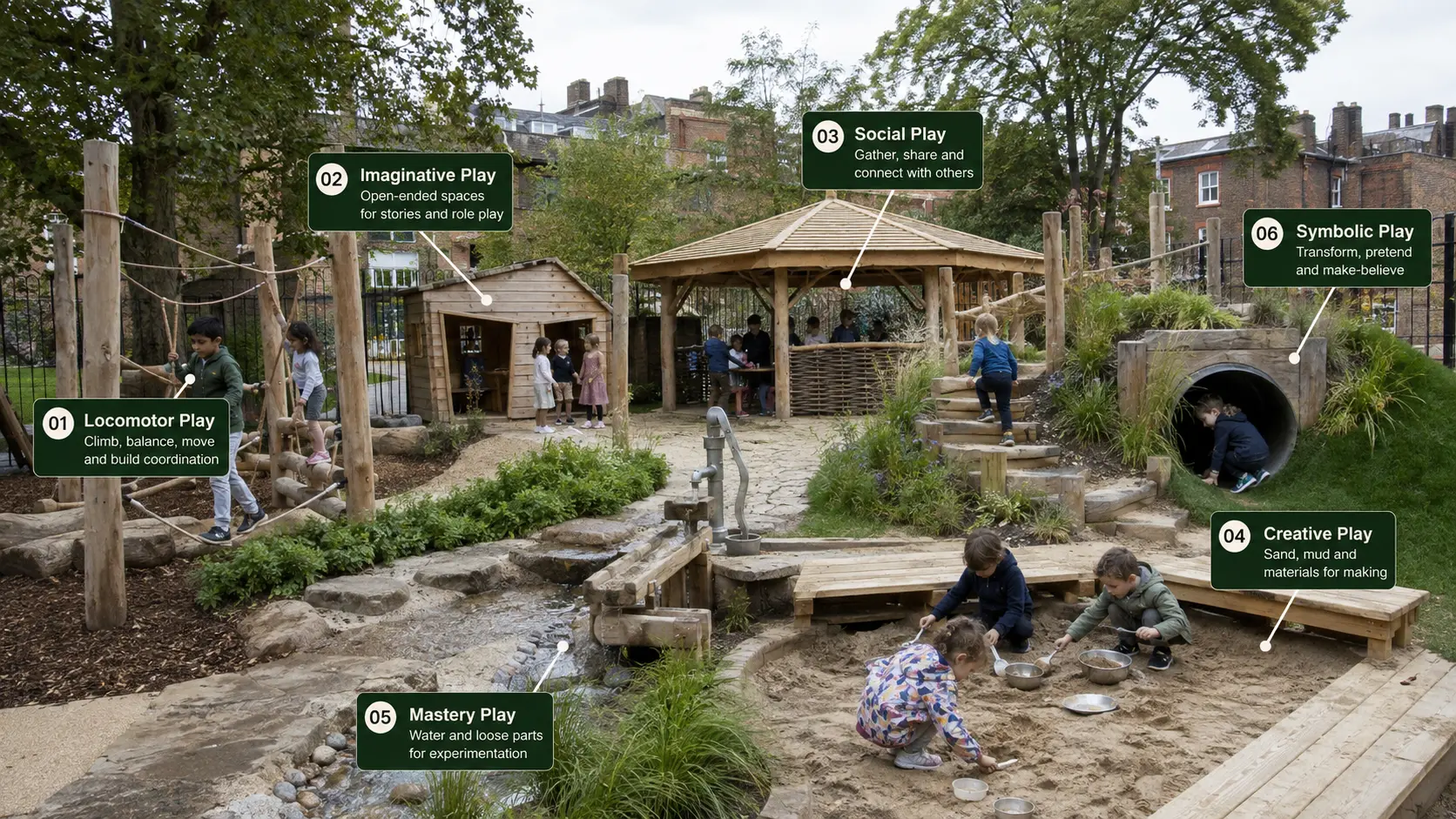
One environment. Many ways to play.
The aim isn't six pieces of equipment for six kinds of play. Good design lets experiences overlap, so the same space works differently for every child who uses it.
01 — Locomotor Play
Climbing, balancing, crossing, jumping and finding different routes through a space.
02 — Imaginative Play
A small timber structure might become a house, shop, den, ship, hideout or something adults haven't thought of.
03 — Social Play
Talking, negotiating, cooperating, creating rules and simply spending time together.
04 — Creative Play
Mixing, shaping, building, combining and expressing ideas using materials.
05 — Mastery Play
Children experiment with how materials behave, how water flows and what happens when they change their surroundings.
06 — Symbolic Play
A log becomes a vehicle. A stick becomes a tool. A tunnel becomes a secret entrance.
A lens, not a checklist.
Every site, age group and brief is different. The 16 Types of Play help us ask better questions and identify opportunities, rather than forcing sixteen separate experiences into every design.
See the thinking in the finished space.
Explore Our Projects03 — Understanding the site
Read the place before drawing anything.
Two sites with identical budgets rarely want the same design. We visit, walk the ground and watch how the space is used before proposing anything.
- 01Who will actually use the space
- 02The ages and stages of those children
- 03The existing environment and how it's used now
- 04The landscape, levels and ground conditions
- 05Available space and circulation
- 06Existing structures, trees and planting
- 07The outcomes the space needs to achieve
04 — Different children
Not every child wants to climb the highest thing there.
Children differ in confidence, ability, interests, sensory preferences and how much challenge they want on any given day. A good environment offers different levels and different forms of joining in.
- Ground-level richness as well as height
- Accessible routes, transfer points and seating
- Quieter corners alongside busy, active areas
- Sensory features — sand, water, texture, sound
- Several ways into the same experience
05 — Natural materials & craftsmanship
It should feel made, not manufactured.
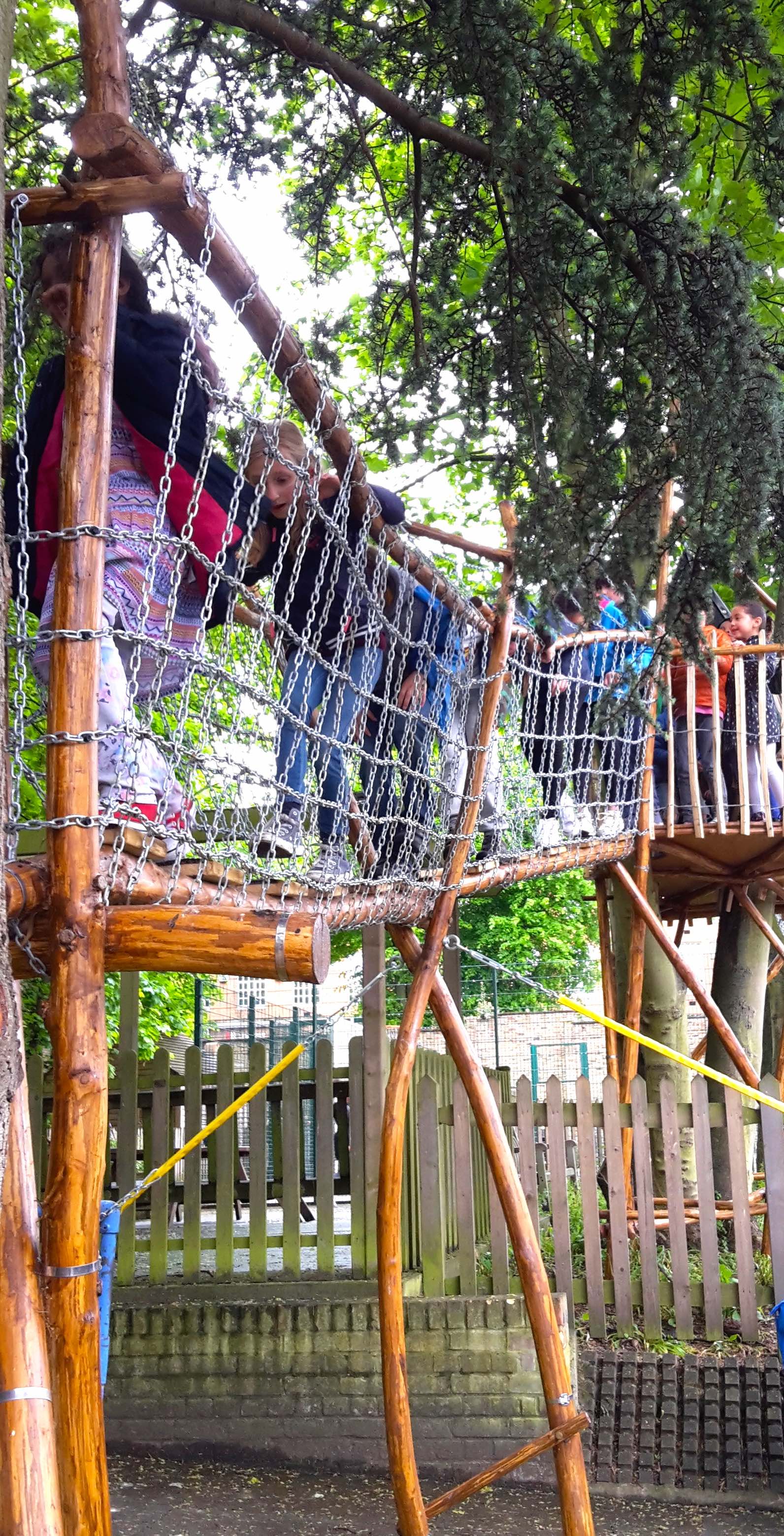
We build in timber and rope because they weather beautifully, feel good under a child's hands and settle into a landscape rather than sitting on top of it. Material choice is also a durability decision: structural timber, heavy-duty rope systems and fixings specified for demanding outdoor life.
The construction is done by the same craftspeople who design it, which is why the details — a shaped handhold, a step in the right place — tend to be right.
06 — Challenge & social play
Challenge, confidence and playing together.
Appropriate challenge
Height, wobble and judgement designed in — with the hazards a child cannot assess designed out.
Confidence
Multiple routes let each child progress at their own pace and discover what they're capable of.
Social play
Platforms, shelters and shared spaces give children reasons to gather, negotiate and play together.
07 — From concept to build
From first conversation to first climb.
- 01
Talk
Tell us about the site, children, budget and what you want the space to achieve.
- 02
Explore
We visit the site, understand the environment and identify the opportunities.
- 03
Design
We develop a bespoke concept based around the children, setting and intended play experiences.
- 04
Build
Our team brings the design to life using carefully selected materials and skilled construction.
- 05
Play
The completed structure is inspected, handed over and ready for children to make it their own.
Tell us who will be playing here.
That is always where we begin. Share the site, the children and what you'd like the space to achieve.