Play & Development
The 16 Types of Play: A Guide to Designing Better Play Spaces
A useful framework for noticing what a play space makes possible — and what it may be missing.
By Got Children First Team · 11 September 2026 · 4 min read
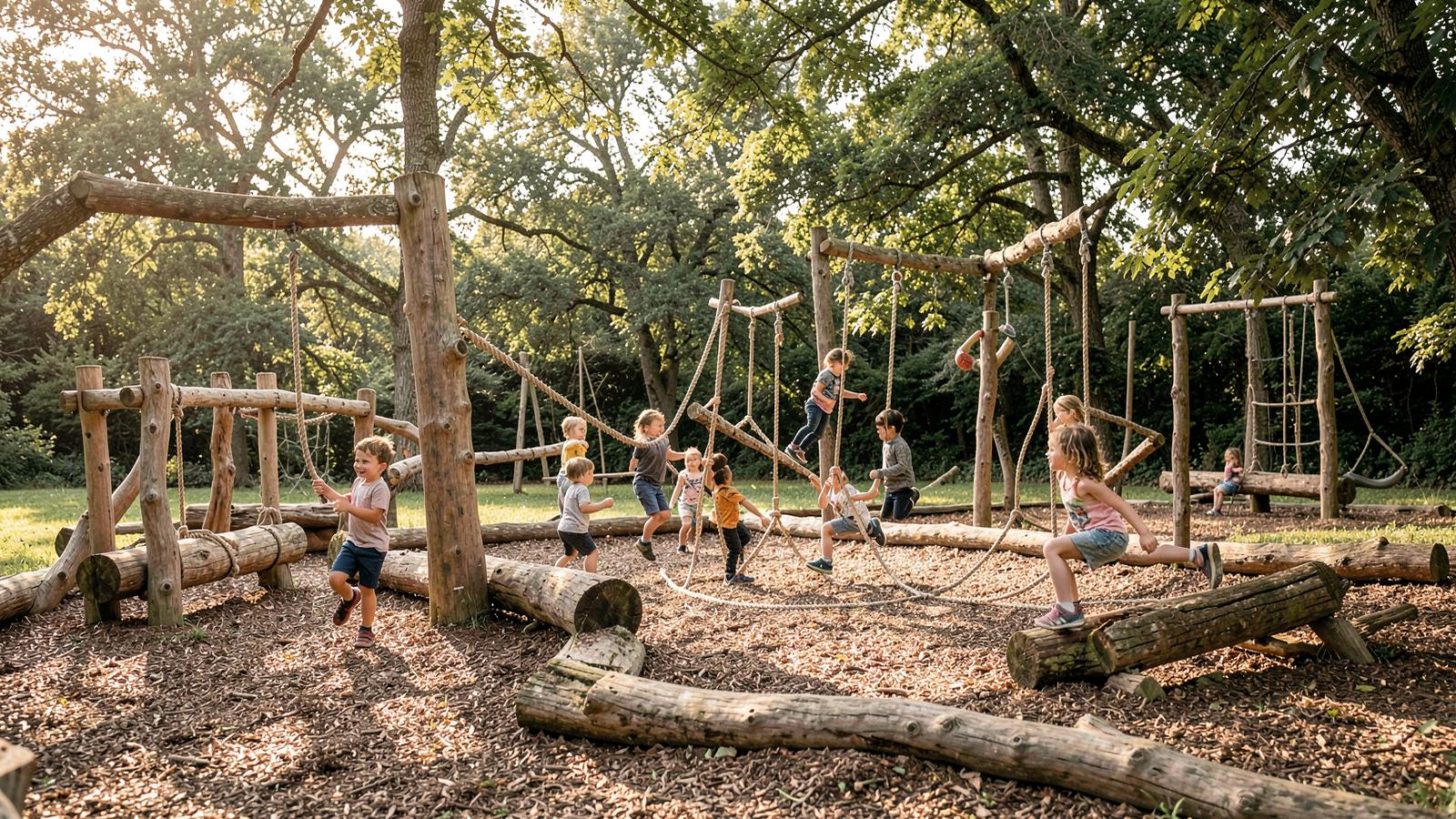
A playground built from a product list can still feel thin. It may contain a slide, a climbing frame and safety surfacing, yet give children little reason to return once they have mastered the obvious route. The difference is often not the amount of equipment. It is whether the space was designed around how children actually play.
Play theorist Bob Hughes described sixteen recurring types of play. [SOURCE REQUIRED] We use that framework as a lens rather than a checklist: a way to ask what experiences a place offers, where it feels narrow, and how a few thoughtful changes might widen the possibilities.
A lens, not sixteen boxes
Trying to provide one item for every play type would produce a cluttered and incoherent playground. The types overlap. A single sloping bank can support locomotor play as children run and roll, deep play as they judge speed and height, and imaginative play when the bank becomes a fort or a mountain.
The value of the framework is diagnostic. It helps a design team notice when a proposal is strong in physical movement but weak in making, conversation, retreat or invention. That can change a brief before money is committed.
The sixteen types in plain language
- Communication play: jokes, stories, singing, mime and the many ways children exchange meaning.
- Creative play: exploring materials, forms and ideas to make something new.
- Deep play: encountering an element of danger in a context where children can test themselves.
- Dramatic play: acting out events that are not part of everyday personal experience.
- Exploratory play: discovering how a space, material or object behaves.
- Fantasy play: entering an imagined world where ordinary rules no longer apply.
- Imaginative play: transforming the familiar — a platform becomes a ship or a shop.
- Locomotor play: movement for its own sake, including running, climbing and swinging.
- Mastery play: controlling the physical environment, perhaps through digging, damming or building.
- Object play: handling and rearranging objects through curiosity and experimentation.
- Recapitulative play: engaging with elemental experiences such as fire, earth, water and shelter.
- Role play: trying out identities and behaviours from everyday life.
- Rough and tumble play: playful chasing, wrestling and testing of strength.
- Social play: making rules, negotiating, cooperating and belonging to a group.
- Socio-dramatic play: acting out real and imagined situations together.
- Symbolic play: allowing one object or gesture to stand for another.
What this changes in a design
A natural climbing structure can offer far more than a route up and down. The Treehouse and Rope Adventure allows children to choose between crossings and heights, supporting movement, judgement, social negotiation and imagined worlds within one connected structure.
Loose materials create a different richness. Sand, water, timber pieces and natural finds can be moved, combined and given new meanings. They support object, creative, mastery and symbolic play because the child — not the equipment — decides what happens next.
Quiet places matter too. Communication and social play need somewhere to pause, talk, watch and decide whether to join in. A playground filled edge to edge with apparatus can unintentionally remove those opportunities.
Challenge without avoidable hazard
Deep and rough-and-tumble play are often designed out because they are mistaken for poor safety. Good design makes a clearer distinction between a visible challenge a child can assess and an unseen hazard they cannot reasonably anticipate. Risk-benefit thinking, suitable surfacing, thoughtful fall zones and clear inspection arrangements can support challenge without abandoning care. [SOURCE REQUIRED]
Designing for different children
Not every child wants the same experience at the same moment. Some arrive ready to climb to the highest platform. Others need a low route, a sensory activity, a place to observe or a friend to go first. Rich spaces let children enter at different levels without making anyone feel that they have been sent to a lesser area.
That is why the framework also supports inclusion. It moves the conversation beyond access to one item and towards meaningful participation across movement, imagination, making, communication and retreat.
Questions worth asking
When reviewing a plan, ask:
- Can children change or reinterpret anything here?
- Are there several routes and levels of challenge?
- Is there room to gather as well as move?
- Can a child watch before joining in?
- Do natural materials, planting or terrain add experiences equipment cannot?
- Will the space still invite new games once the obvious activities are familiar?
Our fuller explanation of the framework sits within Our Approach. The aim is not to claim that every playground delivers all sixteen types equally. It is to make deliberate decisions, understand the character of the place, and create more than a collection of things to climb.